
Huron Projected Versus Actual Release
A projected date describes a future event that may occur if the legal and administrative facts remain unchanged. An actual release date records an event that has happened. Huron County’s current jail roster includes a Release Date row, but a future value can appear while the person is still listed as a current inmate. That field must not be turned into an exit confirmation.
The state record uses a combined label: “Expected Release Date/Parole Eligibility Date.” It can describe a projected release or a date when parole consideration becomes possible. Eligibility is not approval. A later state status such as APA Supervision, read with supervision start and release detail, is stronger evidence that prison custody ended.
| Record | What the date means | What confirms exit |
|---|---|---|
| Huron current roster | A listed Release Date may be prospective | Sheriff custody record with actual release time and reason |
| ODRC offender detail | Expected release or parole eligibility | Status plus release or supervision detail |
| Court docket | Sentence, credit, bond, or release authority | Jail or prison operational record after all holds clear |
| Parole Board result | Decision stage or later review | Completed release reflected in ODRC status |
Find a Huron Release Date
First identify the custody system. A pretrial detainee at Huron County Jail may have no sentence-completion date because the case, bond, and holds remain open. A locally sentenced person requires the sentencing entry and the jail’s calculation. A state prisoner belongs in the ODRC search. Mixing those records produces a confident but wrong answer. The official Huron current roster is the county starting point.
- Check the official Huron current roster and note its run time. Review every charge, court, disposition, and Release Date row.
- Open the court docket that imposed the sentence. Common Pleas handles felony matters; Norwalk or Bellevue Municipal Court may hold the local case.
- For an ODRC commitment, search by full name or offender number. Match date of birth, docket, and committing county before reading the expected-date field.
- Compare sentence details, jail-time credit, expected date, status, supervision start, assigned office, and any parole-review fields.
- Ask the jail or the Bureau of Sentence Computation to explain a maintained calculation when dates conflict. Do not calculate a replacement date from the public page.
- After the expected day, verify actual departure through the current status and release record. A separate case or detainer may prevent exit.
The ODRC offender search exposes name, county, status, offender number, and hearing-month filters.
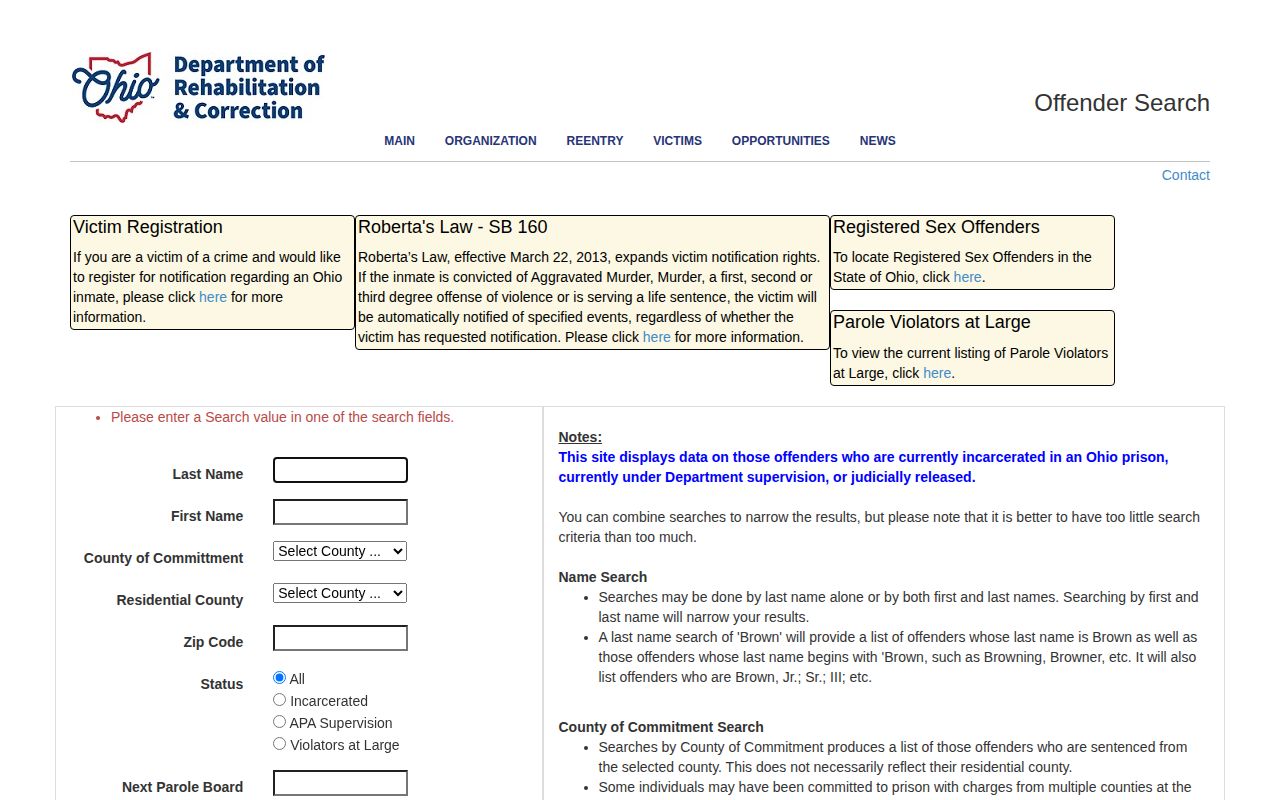
The search form separates commitment county from residential county. Huron as the commitment county points to the sentencing source, while Huron as residential county applies to certain supervision records.
Huron Jail Release Date Limits
A Huron County pretrial detainee does not have a fixed sentence end. Bond may be posted, a judge may change conditions, a case may be dismissed, or another hold may remain. Even a “Court Order Released” disposition on one charge does not override a second case, warrant, detainer, or sentence. Staff must clear the whole booking before physical departure.
For a local jail sentence, the court entry, jail-time credit, concurrent or consecutive terms, and all other custody authority affect the date. Concurrent terms run at the same time; consecutive terms run one after another. Jail-time credit counts qualifying prior confinement toward a sentence. Use the Huron County Clerk case-search page for a Common Pleas sentence. No official Huron County Jail good-time policy or weekend-release rule was found, so no local reduction should be assumed.
Call the jail at 419-668-1996 for a current operational check. The Huron County Sheriff’s Office contact page provides official routing. For a durable record, ask the Sheriff for the booking and custody record, projected date if maintained, actual release timestamp, release authority, reason, and destination. If staff say a calculation belongs to the sentencing court, use the docket and judgment entry rather than asking the office to create new analysis.
Note: Huron County visitation hours do not establish release hours, processing times, weekend practice, or the door used for departures.
Huron ODRC Expected-Date Fields
ODRC’s combined expected-release and parole-eligibility label requires context. It may sit beside an Earliest Possible Transfer Date, POA Date, projected release date, transitional-control expiration, sentence expiration, or next parole hearing. Each field answers a different question. A POA date can mark the earliest state-supervision release point. A hearing month marks a review stage, not a release grant.
The official ODRC field definitions are the best starting point for those labels.
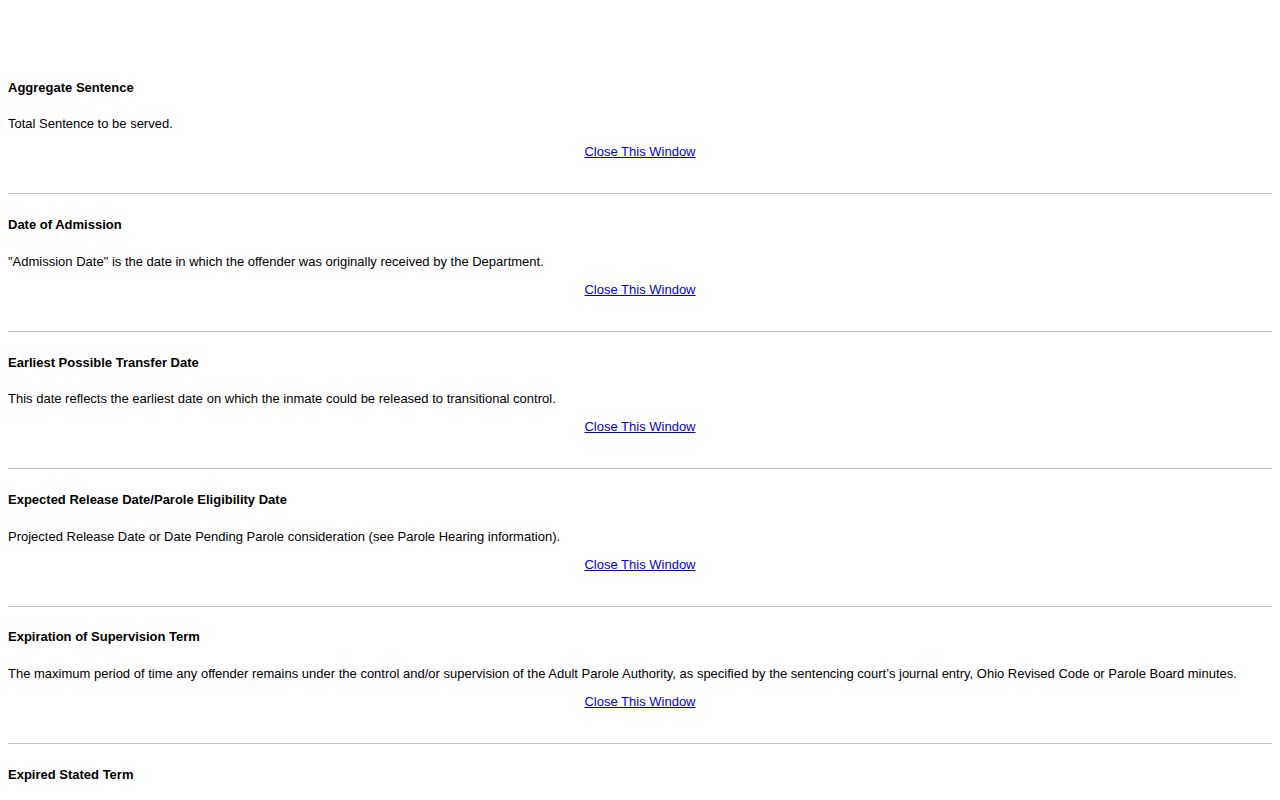
The definitions distinguish the expected or eligibility field from the status and details that appear after release. Keep the ODRC number and full result when asking Central Records about a mismatch.
- Projected release date
- A calculated future date that remains subject to credits, holds, orders, and review.
- Parole eligibility
- The point when the Board may consider release, not a promise that it will grant release.
- Detainer
- A request or legal hold that can keep someone in custody or cause transfer to another agency.
- Judicial release
- A qualifying prison release granted by the sentencing court under Ohio law.
Huron Release Dates and Credit
Ohio’s current earned-credit law is R.C. 2967.194, applicable beginning April 4, 2024. It can authorize provisional credit of one or five days per completed month for productive participation in a qualifying program, based on the statutory category. Up to five more days may be available for successful completion of a second qualifying program or activity. Institutional rule violations can cause credit to be denied or withdrawn.
For the participation and completion credit in subsection (A)(2), the aggregate ceiling is 15 percent of the stated prison term. That cap creates the familiar 85-percent shorthand, but Ohio does not impose one universal rule that every person serves exactly 85 percent. Subsection (A)(3) separately permits another form of completion credit for eligible people, with its own amount and exclusions. Mandatory terms and specified offenses can be excluded.
The statute itself shows the current framework.
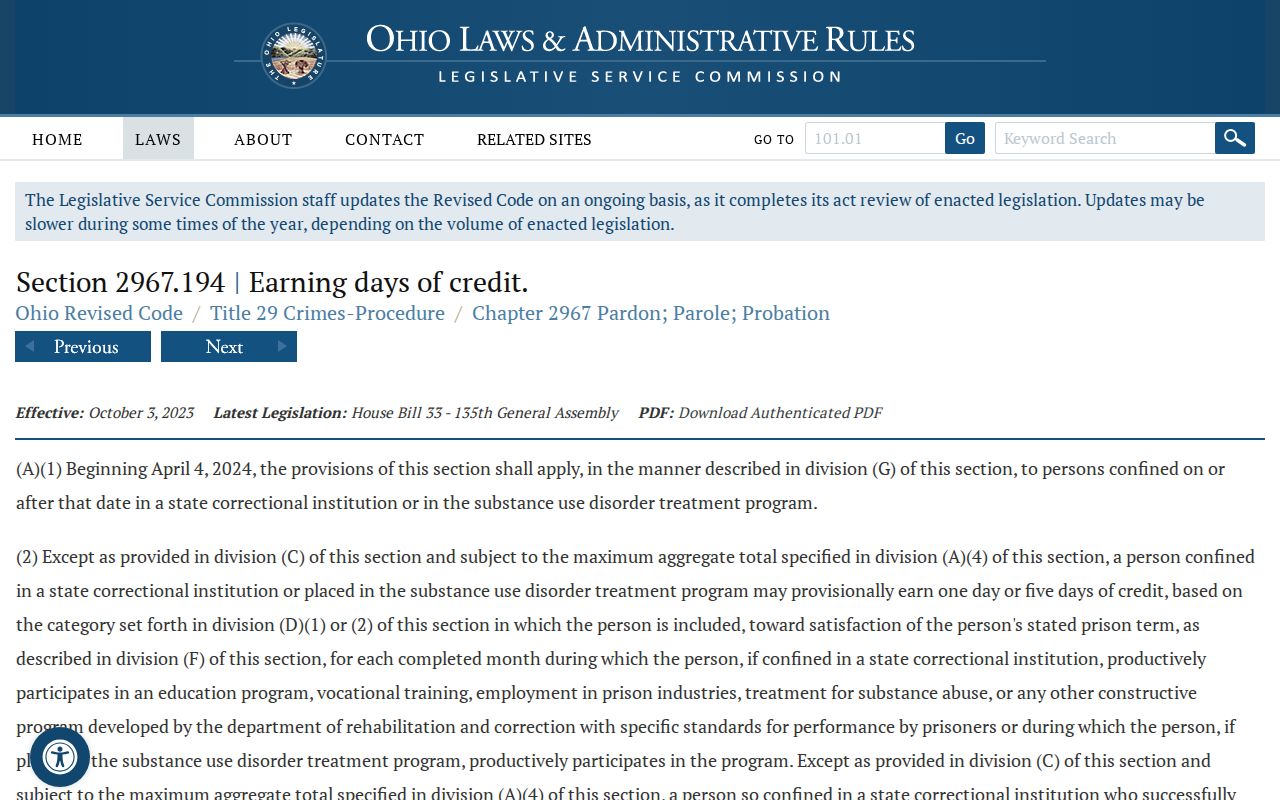
This source is more reliable than applying the former R.C. 2967.193 framework or a flat percentage to every sentence. It still does not provide enough facts to compute one person’s date without the maintained sentence record.
Huron Indefinite and Parole Dates
R.C. 2967.271 governs qualifying non-life indefinite prison terms. It creates a rebuttable presumption of release at the earlier of the minimum term’s end or a court-approved presumptive earned early release date. “Rebuttable” means ODRC may decide after a hearing that statutory conduct, safety, restrictive-placement, or security findings justify continued custody. The maximum term remains the outer limit.
Parole-eligible sentences follow R.C. 2967.13. The statute contains different thresholds for life and other indefinite terms, and life without parole has no eligibility. Eligibility only opens the Board’s review. A recommendation, hearing result, or projected date can still be reviewed, continued, denied, or rescinded before the person physically leaves.
Ohio Administrative Code 5120:1-1-10 also states that a discretionary projected date can be rescinded and creates no entitlement to release. Read the latest Board result, not just the next review month. Then confirm the completed event through ODRC status and release or supervision detail.
Why Huron Release Dates Change
A release estimate is the output of many maintained facts. Any one of them can change. Public fields may also lag the internal record. When two official dates conflict, preserve the query, ODRC number, docket, and full detail page, then ask the agency responsible for the calculation.
| Change | Possible effect | Best verification source |
|---|---|---|
| Jail-time credit correction | Moves the computed sentence endpoint | Sentencing entry and sentence computation |
| Concurrent or consecutive terms | Changes how multiple terms overlap or add | Court judgment and aggregate sentence |
| Earned credit awarded or withdrawn | Advances or delays an eligible prison date | ODRC sentence computation |
| Court modification | Changes the legal sentence or authorizes judicial release | Court docket and ODRC detail |
| Detainer or other case | Prevents community departure or causes transfer | Custody record and receiving agency |
| Parole or indefinite-term review | Grants, continues, denies, rebuts, or rescinds a possible date | Board result and ODRC status |
A transfer also matters. Leaving Huron County Jail for ODRC, another county, federal custody, or immigration custody ends the local stay but is not community release. Follow the receiving system named in the Sheriff’s record.
Confirm a Huron Actual Release
After the estimated date, repeat the correct search. A county-jail release should be confirmed through the Sheriff’s actual exit record and the court order. A state-prison release is supported by ODRC status, parole or release detail, and a supervision start when applicable. The Huron VINELink release check can add notification for a selected participating custody record, but it is not a sentence calculator.
Use an evidence order when the public fields do not agree. A future expected or eligibility date describes a possible event. A Board result records a decision stage. “APA Supervision” with a supervision start date shows that state-prison custody ended and supervision began. A released qualifier with release detail supplies stronger departure evidence, while a response from Central Records provides formal state confirmation through this channel. None of those fields gives the actual exit time from Huron County Jail unless the question concerns the later release from an ODRC term.
Keep enough detail for the agency to locate the same custody episode. Record the date of the search, exact query, full name, date of birth, offender number, committing county, and docket. Names can collide, and a Huron county filter can refer to commitment or last recorded residence. Those identifiers let staff address the maintained record without guessing which person or sentence is at issue.
If ODRC fields remain inconsistent, write Central Records at P.O. Box 430, Columbus, OH 43216. Calculation questions go to the Bureau of Sentence Computation at P.O. Box 2650, Columbus, OH 43216, or 614-466-3749. Include the full name and ODRC number.
For a Huron County jail case, use the county release search and record path to match roster status, the court docket, and the Sheriff’s actual release timestamp. That evidence distinguishes a completed release from an estimate, a transfer, or a favorable entry on only one charge.
Note: VINE supplies custody-change alerts where available, but the jail, court, or ODRC remains the source for release-date computation.