
Huron County VINELink Coverage
Ohio VINE is a free, anonymous custody-information and notification service accessed through VINELink and the state's telephone route. Ohio Attorney General material describes statewide coverage that combines county jail booking feeds with state-prison data. The live service should still be checked for the specific Huron County booking because the official material found does not publish a current county-by-county participation list.
VINELink serves two related purposes. It can display custody information for one matching record, and it can register a person to receive an alert about release, transfer, or another reported change. The service does not create the event. It passes data from the participating agency, so the meaning and timing depend on that agency's record.
Coverage stops at system boundaries. VINELink does not cover Bureau of Prisons federal custody. It also should not be used to calculate a sentence or turn a projected date into a promise. A Huron County jail record, an ODRC prison record, and a federal record require different official checks.
Search Huron County VINELink Records
Start with enough identifying detail to avoid a false match. Similar names can appear, and a person can move between custody systems. Use the exact spelling available from the booking or court record. If VINELink offers an identifier field, compare that value along with the name and agency before opening or registering on a result.
- Open VINELink and choose Ohio from the state-selection screen.
- Select the person or offender search offered by the live service.
- Enter the available name or identifier fields. Avoid guessing at an ID.
- Compare all displayed identifiers when more than one result appears.
- Open the matching record and read the agency, location, custody status, and event details together.
- If no match appears, check the jail, ODRC, court, or federal source that fits the last known custody.
The VINELink state-selection and search interface is shown below as captured for this project.
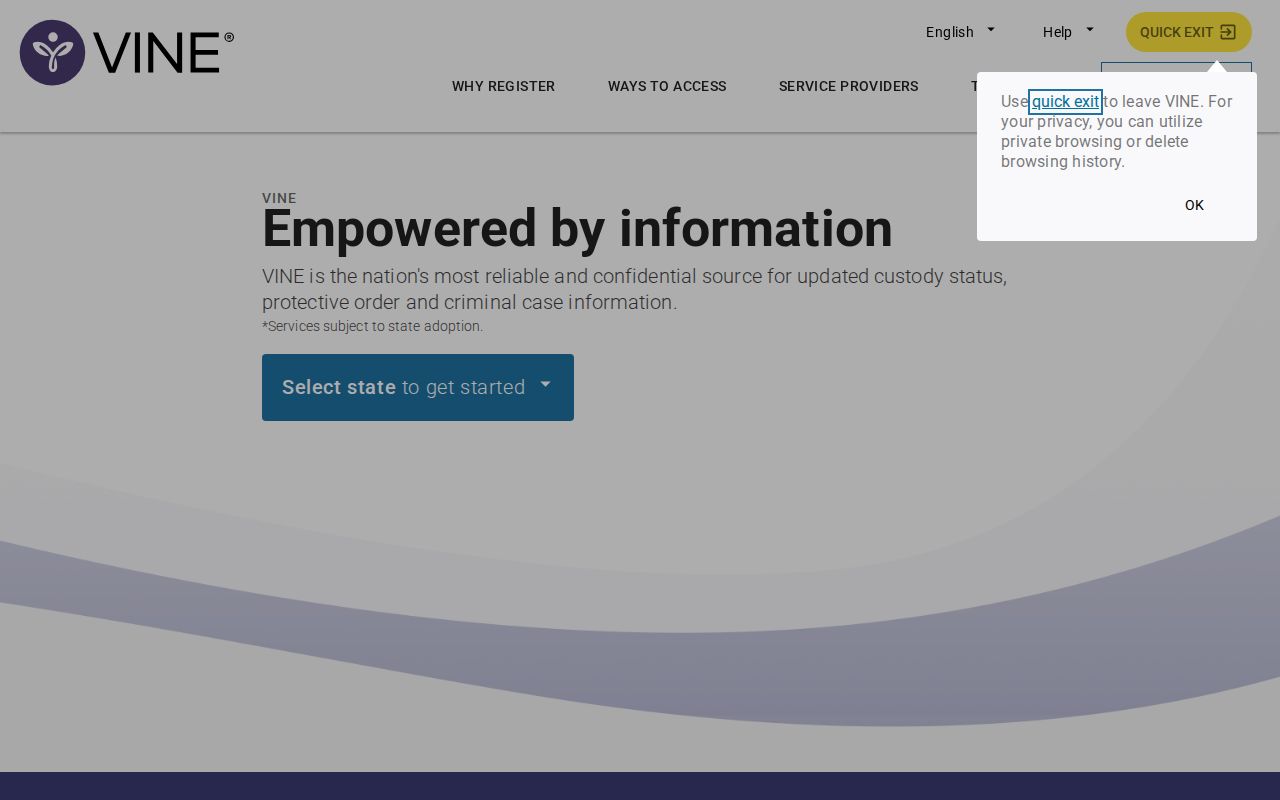
Choose Ohio first, then rely on the fields and registration choices shown for the live matching record rather than assuming every agency publishes identical detail.
For a person who last appeared at Huron County Jail, absence from VINELink is not proof that the person left. Check the Sheriff's current roster, call the jail, and request the actual release record. A full Huron County released inmate verification can also trace the court and receiving system.
Huron VINELink Release Result Fields
No authentic released Huron County result screen was located in the research. That means an exact status phrase or fixed result layout should not be promised. Review what the participating agency supplies and interpret the fields as a set. A custody change may be a release, transfer, or other reported event.
| Result element | How to use it |
|---|---|
| Name and identifier | Confirm that the result belongs to the intended person and custody record. |
| Reporting agency | Shows which office supplied the event and should confirm it. |
| Custody status | Describes the status currently reported through that participating record. |
| Facility or location | Helps separate Huron County jail custody from state-prison custody. |
| Event or release information | Reports the agency's custody change, subject to lag and later correction. |
| Notification choices | Shows which phone, email, SMS, or TTY routes may be registered. |
A transfer is not community release. It may mean the person entered ODRC, another county jail, federal custody, or another agency's control. Likewise, an expected release date is not the same as a completed exit. Confirm the event with the reporting office when timing or destination matters.
Note: Save the agency name and record identifier before calling because they help staff find the same custody episode.
Register Huron County Release Alerts
Registration begins from the matching person record, not from a general county list. Select the notification or registration option shown in VINELink, then choose among the offered telephone, email, SMS, or TTY channels. Multiple telephone or email contacts may be registered. Availability can vary by record and service interface.
- Confirm the person's name, identifier, reporting agency, and custody location.
- Open the notification or registration control on that matching record.
- Select each offered channel that fits the notification need.
- For telephone alerts, create a four-digit PIN and store it securely.
- When a call arrives, enter the PIN to acknowledge the alert.
- After any alert, contact the reporting or receiving agency to verify the event.
Email registration does not use the telephone PIN. If the phone PIN is forgotten, call Ohio VINE at 1-800-770-0192 and press 0 for a representative. Do not use personal details that others can easily guess when choosing the four-digit value.
An alert can be important, but it is not a complete release record. The notification tells the registrant that the connected agency reported a change. The agency record supplies the actual authority, timestamp, and destination. Keep those roles separate.
Ohio VINE Phone Alert Mechanics
Ohio's notification layer combines Attorney General support, booking-system data from sheriffs, state-prison information, a round-the-clock telephone service, and anonymous multichannel registration. The four-digit PIN has one key purpose: it tells the automated phone system that the alert reached the registrant.
If a call is not acknowledged, the system can continue calling for up to 48 hours. That repeat window is not a measure of how long the person remained in custody. It is only part of the notification delivery process. Email needs no PIN, and a message should still be checked against the live record and the responsible agency.
The Ohio Attorney General notification page explains the state-supported service and its safety limits.
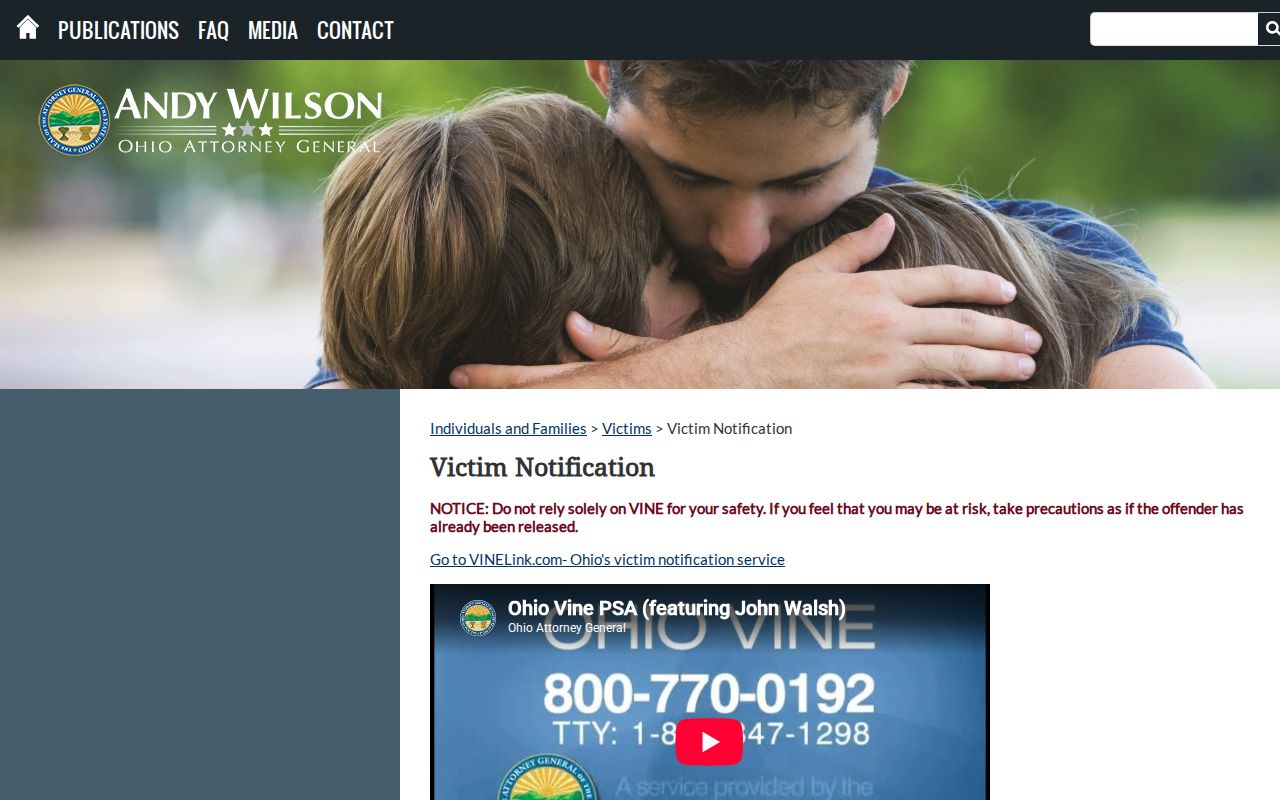
The state expressly warns users not to rely on VINE alone, so each Huron County alert should lead to agency confirmation.
Confirm Huron VINELink Release Changes
Data can lag. Agency participation and record detail can differ, and a missing result has several possible causes. The person may be under a name variant, outside the covered agency, transferred, released, or absent because of data timing. VINELink should not be used as sole proof of any one explanation.
For Huron County Jail, check the Sheriff's current roster, then call 419-668-1996 and request the custody record when a durable answer is needed. Ask for the actual release date and time, release authority or reason, and destination or receiving agency. Court dockets can support bond, dismissal, sentence, or transfer authority, but they may not show the minute of physical exit.
For a state-prison case, use the ODRC offender search. It covers incarcerated people, released records, APA supervision, and violators at large. Compare status with the parole or release detail and supervision start. ODRC's Expected Release Date/Parole Eligibility Date is a combined prospective field, not proof of an actual departure.
ODRC can be searched by last and first name or by offender number. County of Commitment identifies the sentencing county, while Residential County applies to APA Supervision and Violators at Large and reflects the last recorded residence. Neither field alone proves that a person is physically in Huron County. Open the detail and compare the ODRC number, birth information, committing county, docket, status, and release or supervision fields. If the maintained state record conflicts with a VINELink alert, ODRC Central Records can address formal state release or discharge verification.
Route Huron Release Checks Correctly
Start with the person's last known system. A Huron County arrest generally points to the county jail and local court. A state-prison sentence points to ODRC. A federal sentence points to the Bureau of Prisons, while civil immigration custody has a separate ICE locator. No one portal contains every stage.
| Last known custody | Primary confirmation source | VINELink role |
|---|---|---|
| Huron County Jail | Sheriff custody record and court docket | Alert and status support when the record is available |
| Ohio state prison | ODRC offender search and Central Records | State custody-change notice |
| Federal prison | BOP Inmate Locator | Not covered |
| ICE custody | ICE Online Detainee Locator and ICE records | Not the primary locator |
ODRC status terms also need care. APA Supervision means the person left state prison for community supervision. Released with a judicial-release qualifier reflects a court-authorized state-prison release. A death qualifier is not community return. Violator at Large refers to an alleged supervision absconder, not a current street location.
A Huron County roster disappearance remains only a clue. Pair the Sheriff's actual exit record with the court or receiving system. VINELink then adds timely notice, not a substitute for those source records.
For an older local case, the relevant Huron court docket may remain available after the jail record drops from the live roster. Common Pleas handles felony and state-commitment history. Norwalk Municipal Court covers most local matters, while Bellevue Municipal Court covers Bellevue and the county's Lyme and Sherman Townships within its territory. Court entries can support the legal reason for a custody change, but the Sheriff's actual timestamp remains the source for the physical jail exit.
Note: Record the date and time of every lookup because custody and notification data can change after an agency update.
Use Huron Release Alerts Safely
Notification is designed to reduce uncertainty about reported custody changes. It does not provide a complete safety plan and cannot predict where a person will go after release. The Ohio Attorney General warns against relying on the service alone. Anyone with a case-specific safety concern should use the official contacts and plans already provided by the relevant agency or court.
Keep registration information current. If a phone number or email changes, update the notification route tied to the record when the service permits it. Test access to the saved PIN before an expected event, and do not wait for a future alert to confirm a custody status that matters now.
After a release or transfer notice, capture the time of the alert, reopen the matching record, and contact the named agency. Ask whether the change was community release, transfer, or another event. That short confirmation chain preserves what VINELink does best while accounting for its limits.